


Latin Language History Fascinating Facts and Lasting Influence

Updated: Sep 25
Latin began as the local speech of a small community near the Tiber River. It ended up naming planets, shaping courtrooms, filling church music, classifying living things, and leaving fingerprints on everyday words like animal, memory, family, and video.
That journey is one of the great surprises in language history. Latin did not simply “die” when Rome fell. It changed homes. It moved from the street to the schoolroom, from law courts to monasteries, from poetry to anatomy texts, and from carved stone to scientific naming systems. Its story is partly imperial, partly literary, and partly a lesson in how languages survive by adapting.
This Latin Language History Fascinating Facts and Lasting Influence guide follows the language from its early roots to its modern echoes, with a few strange and memorable stops along the way.

Latin grew from a local dialect into the voice of Rome
Latin belongs to the Italic branch of the Indo-European language family. Long before it became the language of an empire, it was one of several languages spoken on the Italian peninsula. Other neighbors included Oscan, Umbrian, Etruscan, and Greek, each with its own cultural weight.
The name “Latin” comes from Latium, the region around Rome. Early Rome was not born speaking the polished language of Cicero and Virgil. Its language developed slowly through contact, conquest, trade, and imitation.
Some of the oldest Latin evidence survives in inscriptions rather than books. These early texts can look strange even to people who have studied Classical Latin. Spellings were not fixed, grammar was still shifting, and the alphabet itself came through contact with Etruscan and Greek writing systems.
One famous early example is the Duenos inscription, often dated to the 6th century BC. Scholars still debate parts of its meaning. That uncertainty is part of the charm. Latin, before it became the language of school exercises and mottos, was a living and sometimes messy human language.
The growth of Latin followed Rome’s own rise.
Period | What changed |
Early Latin | Local speech in Latium developed alongside neighboring Italic languages. |
Old Latin | Inscriptions, laws, and early literature began to show Latin in public use. |
Classical Latin | Writers such as Cicero, Caesar, Virgil, Horace, Ovid, and Livy shaped the style later generations treated as a model. |
Vulgar Latin | Everyday spoken Latin varied across the empire and slowly formed the roots of the Romance languages. |
Medieval Latin | Scholars, clergy, and officials used Latin across Europe after the western Roman Empire fell. |
Renaissance and scientific Latin | Humanists revived classical style, while scientists used Latin to name and describe the natural world. |
A lively detail often gets missed: Latin expanded not because every conquered person instantly abandoned their language. Rome ruled a multilingual world. Greek remained hugely important in the eastern Mediterranean. Local languages survived for centuries in many places. Latin spread strongest where Roman administration, military service, settlement, law, and trade made it useful.
In other words, Latin became powerful because people had reasons to use it.
Classical Latin turned language into art and authority
By the late Roman Republic and early Empire, Latin had entered its most famous literary phase. This is the Latin many students meet first: balanced, carefully arranged, and deeply tied to public life.
Cicero used Latin as a tool of persuasion. Julius Caesar wrote prose that still feels direct and controlled. Virgil turned Rome’s origin story into epic poetry in the Aeneid. Ovid made myth playful and elegant in the Metamorphoses. Livy narrated Rome’s past on a grand scale.
These writers did not just record Latin. They helped define what later readers thought “good Latin” should sound like.
Latin became a prestige language in part because Rome’s best writers made it feel precise, flexible, and memorable.
Classical Latin had features that can surprise modern English speakers. Word order mattered, but endings did much of the grammatical work. A noun’s role in a sentence depended on its case ending. That meant a poet could move words around for rhythm, emphasis, or suspense while still keeping the meaning clear.
For example, Latin poetry could separate an adjective from its noun, wrap one phrase around another, or place a key word at the end of a line for dramatic effect. Roman writers loved that flexibility.
Latin also absorbed ideas from Greek. Educated Romans admired Greek literature, philosophy, rhetoric, and science. Many Roman elites learned Greek, and Latin writers borrowed Greek genres with ambition. Comedy, tragedy, epic, history, philosophy, and technical writing all entered Latin partly through Greek models.
One landmark came in the 3rd century BC, when Livius Andronicus translated Greek works into Latin, including an early version of the Odyssey. That act mattered. It showed Latin could carry the weight of high literature, not just law, farming, military commands, and everyday talk.
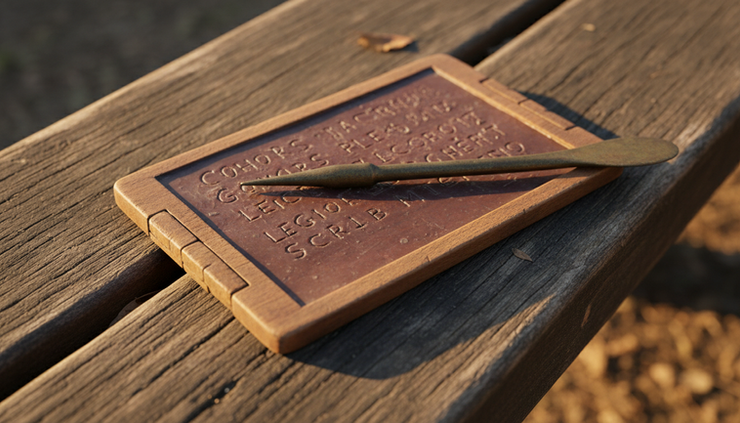
Latin also became the language of authority. Roman law, public inscriptions, military records, and official decrees gave it a formal force. Even short inscriptions could project power. A carved phrase on stone did not need to be long to announce who built a road, dedicated a temple, won a battle, or held office.
Anecdotes from Roman culture show how seriously people took language. Cicero criticized sloppy speech and praised cultivated style. Graffiti from Pompeii, by contrast, shows the lively Latin of ordinary people: jokes, insults, love notes, advertisements, and political slogans. Some graffiti proves that people made spelling mistakes, enjoyed wordplay, and complained about daily life much as people do now.
That mix gives Latin texture. It was never only marble and speeches. It also lived on walls, cups, receipts, tombstones, and jokes.
Spoken Latin did not die so much as become new languages
People often say Latin is a dead language. That phrase can mislead. Classical Latin no longer has native speakers, but spoken Latin evolved into living languages.
The everyday Latin spoken by soldiers, merchants, settlers, enslaved people, farmers, and families is often called Vulgar Latin. “Vulgar” here does not mean rude. It comes from the Latin vulgus, meaning common people. This was the Latin of daily life, and it varied by region.
As the western Roman Empire weakened, local forms of spoken Latin kept changing. Over centuries, they became Spanish, Portuguese, French, Italian, Romanian, Catalan, Occitan, Sardinian, Romansh, and other Romance languages.
The changes were gradual. No one woke up one morning speaking “French” instead of Latin. Sound shifts, grammar changes, local vocabulary, and contact with other languages slowly created new forms of speech.
A few broad patterns show the family resemblance:
Latin word | Meaning | Modern descendants |
mater | mother | madre, mère, mãe |
pater | father | padre, père, pai |
aqua | water | agua, acqua |
luna | moon | luna, lune |
bonus | good | bueno, buon, bon |
English is not a Romance language. It belongs to the Germanic family. Still, Latin shaped English in major ways. Some influence came through Christianity and scholarship. A large amount came through French after the Norman Conquest of England in 1066. Since French developed from Latin, thousands of Latin-based words entered English through French.
That is why English often has Germanic words for plain daily things and Latin-based words for formal, legal, or academic ideas. Compare:
ask and inquire
kingly and royal
help and assist
build and construct
fear and terror
These pairs are not exact duplicates. They carry different tones. English gained a layered vocabulary because of its mixed history.
Latin also appears in legal language. Terms such as habeas corpus, subpoena, pro bono, affidavit, and amicus curiae still appear in American courts and legal writing. Some are used daily by lawyers. Others survive because they name concepts with long institutional histories.

The survival of Latin after Rome also depended on the Christian church. As Christianity spread through western Europe, Latin became central to theology, worship, administration, and learning. Jerome’s Latin Bible translation, known as the Vulgate, held enormous influence for centuries.
During the early Middle Ages, Latin connected scholars who spoke different native languages. A monk in Ireland, a scholar in France, and a church official in Italy might not speak the same everyday tongue, but they could read and write Latin.
Charlemagne’s reforms in the late 8th and early 9th centuries helped standardize learning and handwriting. The script known as Carolingian minuscule made texts easier to read and copy. Much later, Renaissance printers and humanists admired that clear script, and it helped shape the lowercase letters familiar in modern type.
That is a quiet legacy, but a huge one. The way letters look on a page owes something to Latin’s medieval life.
Latin gave literature, science, and learning a shared language
Latin’s role in literature did not end with ancient Rome. Medieval writers composed hymns, histories, satire, philosophy, and poetry in Latin. Some wrote with classical elegance. Others used a more flexible medieval style that fit new subjects and Christian thought.
The student song “Gaudeamus igitur,” for example, survives as a cheerful academic Latin song. The 13th-century collection known as Carmina Burana includes earthy, comic, religious, and lyrical Latin poems. Latin could be sacred, serious, playful, and sharp.
Renaissance humanists later tried to revive the style of ancient Roman authors. They treated Cicero and Virgil as models of taste. This return to classical form changed education across Europe. For centuries, learning Latin meant training the mind through grammar, translation, imitation, and rhetoric.
Science also leaned heavily on Latin. European scholars used it because it crossed borders. A botanist in Sweden, a physician in Italy, and an anatomist in the Netherlands could share work in a common learned language.
Carl Linnaeus helped establish the binomial naming system for organisms in the 18th century. Scientific names use Latin or Latinized forms, which is why the gray wolf is Canis lupus and humans are Homo sapiens. These names avoid some confusion caused by local common names. A plant might have many names in different languages, but a Latin scientific name gives researchers a shared reference point.
Latin shaped medicine too. Anatomy uses many Latin terms, such as femur, tibia, radius, cornea, and vertebra. Some terms come through Greek as well, since ancient medicine drew from both traditions. The result is a scientific vocabulary where Latin and Greek often work side by side.
Astronomy carries the same inheritance. Planet names such as Mercury, Venus, Mars, Jupiter, Saturn, Uranus, and Neptune come from Roman mythology, although Uranus has a Greek origin filtered through classical tradition. Many constellations also have Latin names, including Ursa Major, Aquila, and Leo.
Even modern mottos keep Latin visible. The United States uses E pluribus unum, commonly translated as “Out of many, one.” Universities, states, military units, and cities often use Latin phrases because they sound compact and ceremonial.
Some familiar Latin phrases have traveled especially well:
Latin phrase | Common meaning |
Et cetera | And the rest |
Ad hoc | For this specific purpose |
Per capita | By each person |
Status quo | The existing state of things |
Mea culpa | My fault |
Carpe diem | Seize the day |
A lesser-known fact: the word video is Latin. It means “I see.” Long before screens and streaming, it was just a first-person verb. The modern word feels technological, but its root is ancient.
The same goes for audio, meaning “I hear.” Two ordinary Latin verbs became central to modern media.

Latin still rewards curiosity
Latin’s influence lasts because it filled so many roles. It was a mother tongue, an imperial language, a literary instrument, a church language, a school subject, a legal tool, and a scientific standard. Few languages have lived so many lives.
Its story also reminds us that languages do not remain fixed. The polished Latin of Virgil was not the same as the Latin scratched on a tavern wall. Medieval Latin differed from Cicero’s prose. Scientific Latin borrowed, adapted, and invented. The Romance languages did not betray Latin. They continued it in new forms.
Learning even a little Latin can make familiar words feel newly alive. Manual links to manus, the hand. Aquatic links to aqua, water. Lunar links to luna, the moon. Memory reaches back to memoria. These connections turn vocabulary into archaeology.
Latin may not be heard in marketplaces as it once was, but it still speaks through books, law, medicine, biology, music, mottos, and the languages used by hundreds of millions of people. Its legacy is not frozen in the past. It keeps appearing wherever old words find new work.


