The Main 5 Languages Spoken in Pittsburgh

Updated: Mar 6
Pittsburgh, Pennsylvania is a city shaped by immigration, industry, and cultural diversity. Over the past century, waves of newcomers have contributed to the region’s unique identity and multilingual communities. Understanding the main languages spoken in Pittsburgh provides insight into the city’s cultural landscape and also highlights the growing need for professional translation services, document translation, and certified translation services for businesses, healthcare providers, schools, and government agencies.
As Pittsburgh continues to attract international students, professionals, and immigrant families, multilingual communication is becoming increasingly important throughout the region.
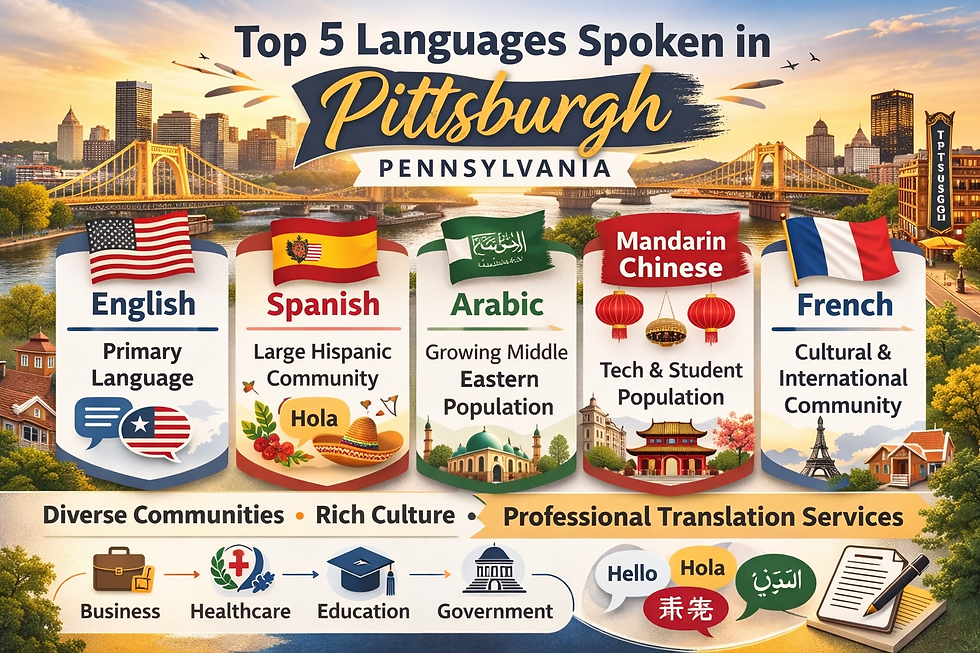
1. English
English is the primary language spoken in Pittsburgh and serves as the main language of communication in government, business, education, and media. Most residents speak English at home or in daily interactions, making it the common language that connects Pittsburgh’s diverse communities.
Despite the dominance of English, the city’s cultural diversity means that many households are bilingual or multilingual, especially in neighborhoods shaped by immigration.
2. Spanish
Spanish is the second most widely spoken language in Pittsburgh. The Hispanic and Latino population in the region has grown steadily over the past two decades, bringing cultural traditions, cuisine, and businesses that enrich the city.
Spanish is commonly heard in neighborhoods, local markets, community organizations, and schools. As the Spanish-speaking population continues to expand, there is increasing demand for Spanish document translation, Spanish interpretation services, and bilingual communication in healthcare, legal services, education, and public administration.
3. Arabic
Arabic is another important language spoken in Pittsburgh, reflecting the presence of communities from the Middle East and North Africa. Many Arabic-speaking families have settled in the area for education, employment, and business opportunities.
Cultural centers, mosques, and community organizations serve as gathering places where Arabic language and traditions are preserved. Because Arabic is widely used in these communities, Arabic translation services and professional interpretation are often needed for medical appointments, legal documents, and educational materials.
4. Mandarin Chinese
Mandarin Chinese has become increasingly common in Pittsburgh in recent years. The city’s universities and expanding technology sector have attracted students, researchers, and professionals from China.
Mandarin is often spoken within academic environments, international business settings, and community organizations. With Pittsburgh becoming more globally connected, Chinese translation services and document translation help businesses and institutions communicate effectively with Mandarin-speaking individuals.
5. French
French also has a presence in Pittsburgh, particularly among international students, professionals, and immigrants from French-speaking regions of Africa, Canada, and Europe. While the number of native French speakers may be smaller than some other language groups, French remains an important language in cultural organizations, educational programs, and international partnerships.
French language education, cultural events, and international connections help maintain the language’s presence within the city.
Translation Services and Multilingual Communication in Pittsburgh
The variety of languages spoken throughout Pittsburgh highlights the importance of clear and accurate communication across cultures. Businesses, hospitals, schools, and government agencies often rely on professional translation services and certified document translation to ensure that important information is accessible to everyone.
Translation services may be required for:
Immigration and USCIS document translation
Legal contracts and court documents
Medical records and healthcare information
Academic transcripts and educational materials
Business and marketing documents
Accurate translations help organizations avoid misunderstandings while making services accessible to people who speak different languages.
Supporting Multilingual Communities
Pittsburgh’s linguistic diversity reflects the city’s welcoming and evolving character. Each language spoken in the region represents a community with its own traditions, history, and cultural contributions.
By supporting multilingual communication through professional translation and interpretation services, organizations can better serve residents, strengthen community connections, and promote inclusion throughout the region.
As Pittsburgh continues to grow and attract people from around the world, language services will remain an important part of helping individuals and institutions communicate effectively.