


A Guide to Translating Spanish Language Documents in Alaska for State and Federal Agencies

A Spanish document can be clear, valid, and official in the country where it was issued, but that does not mean an Alaska agency can accept it as-is. For many state and federal processes, the document must be translated into English and paired with the right certificate of translation.
That detail matters. A driver’s license application, immigration filing, name change, school registration, professional licensing request, or state benefits application can slow down if the translation is incomplete, uncertified, or submitted with the wrong type of certification.
Silver Bay Translations helps with Spanish document translation in Alaska for DMV, UMV, USCIS, and other state and federal agency needs. That includes translations of driver’s licenses, birth certificates, marriage certificates, divorce records, identification cards, passports, and other personal documents used for official purposes.
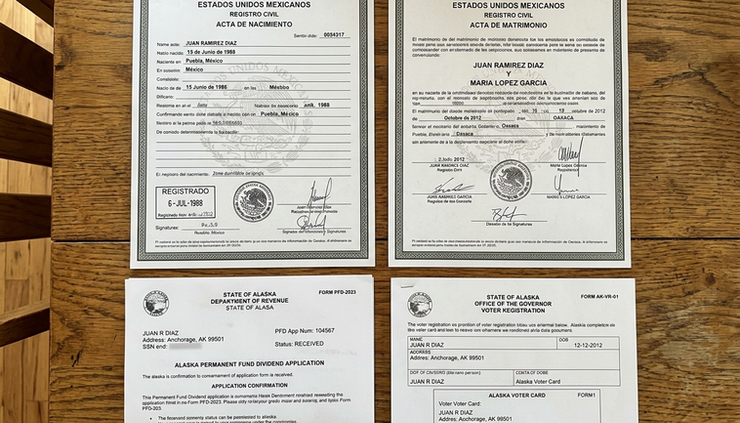
Spanish documents often need more than a word-for-word translation
Official document translation is not the same as casual translation. Many personal records include legal names, dates, places of birth, government seals, registry numbers, handwritten notes, marginal annotations, and formatting that needs to be handled carefully.
A strong official translation should do three things:
Translate the full visible text
This includes stamps, seals, signatures, handwritten notes, warnings, labels, and certification language.
Preserve the meaning of the original
The translation should read naturally in English while staying faithful to the Spanish document.
Support agency review
The receiving agency should be able to compare the translation to the original and understand what each part of the document says.
For example, a birth certificate from Mexico, Colombia, Spain, Peru, El Salvador, or another Spanish-speaking country may include registry information that does not match the layout of a U.S. birth certificate. A translator needs to translate the content accurately without pretending the form is something it is not.
The same applies to marriage certificates. Some records include civil registry language, church references, witness details, or court-related notes. A complete translation helps the agency see the full record, not just the names and date.
Driver’s licenses and identification documents can also be sensitive. They may include abbreviations, license classes, restrictions, issue dates, expiration dates, and official markings. If the translation leaves out those details, the agency may ask for a corrected version.
Alaska DMV and UMV translations may require the COFAT
For Alaska DMV and UMV purposes, certificate requirements can be specific. Silver Bay Translations uses Alaska’s official certificate of translation, known as the COFAT, for DMV and UMV translations when that certificate is required.
This is an important distinction. Many people assume that any certified translation will work for every agency. In practice, agencies can have their own rules. A general certified translation may be suitable for one use, while another office may ask for a specific certificate format.
For Alaska DMV and UMV translations, the COFAT helps show that the translation follows the certificate format used for those agencies. This can be especially important when translating documents connected to:
Driver’s license applications
Out-of-country driver’s licenses
Identification documents
Name verification records
Date of birth verification
Marriage certificates used to support a name change
Birth certificates used to support identity records
A translation for DMV or UMV use should be prepared with the agency’s expectations in mind from the beginning. That includes keeping names consistent, translating all visible text, and using the correct certificate.
For instance, if a Spanish driver’s license includes both paternal and maternal surnames, the translation should reflect the full name as it appears. If a birth certificate includes a parent’s two surnames, that should also be handled consistently. Small details can affect how an agency matches the translation to the applicant’s other records.
Agency requirements can change, and different offices may review documents with different levels of scrutiny. That is why it is wise to confirm the receiving office’s requirements before submitting, especially if the document will be used for a time-sensitive DMV or UMV appointment.
USCIS and federal agencies require certified translations
Federal agencies, including USCIS, commonly require certified English translations for foreign-language documents. For immigration filings, a certified translation is typically submitted with a copy of the original Spanish document.
Silver Bay Translations uses its own official certificate of translation for certified translations, including translations prepared for USCIS and similar federal agency purposes.
A certified translation usually includes a signed statement confirming that the translation is complete and accurate to the best of the translator’s ability. It also identifies the language pair, such as Spanish to English, and includes information about the translator or translation company.
Common Spanish documents translated for USCIS and federal purposes include:
Birth certificates
Marriage certificates
Divorce decrees
Death certificates
Passports
National identity cards
Police certificates
Adoption records
School records
Medical or vaccination records when required
Court records
Name change documents
For USCIS, completeness matters. A translation should not summarize a document, skip seals, or leave out handwritten notes because they look minor. If text appears on the document, it generally needs to be translated or identified when it is illegible.
Certified translations for immigration filings should also be consistent. Names, dates, locations, and document numbers should match the source document as closely as possible. If the original document uses a date format common in Spanish-speaking countries, such as day-month-year, the English translation should make the date clear for U.S. review.
A document may be accepted in one context and rejected in another if the certification does not match what the agency expects. For that reason, a translation intended for USCIS should be prepared as a certified translation, not as a basic informational translation.
A certified translation is not just a translated page. It is a translated document paired with a formal statement of accuracy.
This article is informational only and does not provide legal advice. For immigration strategy or legal questions, consult a qualified immigration attorney or accredited legal representative.

Notarized translations may be needed for some state agency requests
A certified translation and a notarized translation are not the same thing.
A certified translation includes a certificate of translation stating that the translation is complete and accurate. The translator or translation company signs the certificate.
A notarized translation includes a notarial act connected to the signature on the certificate. The notary does not certify the accuracy of the translation. The notary verifies the signing process according to notarial rules.
Some agencies ask only for a certified translation. Others may request notarization. Certain state agency situations, court-related filings, professional licensing matters, or administrative processes may call for a notarized translation upon request.
Silver Bay Translations can provide notarized translations upon request for certain state agency needs. If notarization is required, it should be requested before the translation is finalized so the certificate can be prepared correctly.
Here is a simple way to think about it:
Translation type | Common use |
Certified translation | USCIS, federal filings, many official agency submissions |
COFAT translation | Alaska DMV and UMV translations when the official Alaska certificate is required |
Notarized translation | Certain state agency, court-related, or administrative requests when notarization is specifically requested |
The safest approach is to ask the receiving agency what it requires. If the agency says “certified translation,” that may be different from “notarized translation.” If it asks for the Alaska COFAT, that is different from a standard certificate of translation.
Getting the certificate type right at the start can help avoid delays.
Common Spanish documents translated for Alaska use
Spanish-language documents come from many countries and many document systems. Some are short and simple. Others include several pages, stamps, apostilles, handwritten entries, or registry notes.
Silver Bay Translations can assist with many types of Spanish to English document translations for Alaska and federal use, including:
Driver’s licenses
These may be needed for Alaska DMV or UMV review, license exchange questions, identity support, or driving record matters.
Birth certificates
These are often needed for USCIS, passport-related matters, school enrollment, benefits, identity records, and name verification.
Marriage certificates
These may support immigration filings, name changes, spousal benefits, DMV records, and other legal or administrative matters.
Divorce records
These may be required for immigration, remarriage, benefits, court filings, or personal record updates.
Passports and national ID cards
Agencies may request translations when the identification document includes Spanish-language details that need English review.
School and academic records
Transcripts, diplomas, certificates, and enrollment records may be used for education, employment, licensing, or immigration purposes.
Legal and court documents
These can include custody orders, criminal records, civil registry documents, declarations, and other formal papers.
Apostilles and certifications
If an apostille or government certification is attached to a Spanish document, that text may also need to be translated.
The goal is not only to translate the words. The goal is to create an English version that the receiving agency can review with confidence.
What to provide for a smooth translation
A clear copy of the original document helps the translation process move faster and reduces the chance of questions later. Scans are usually better than phone photos, but a sharp, well-lit photo can work if every part of the document is visible.
For best results, provide:
A complete image or scan of every page
Clear views of seals, stamps, signatures, and margins
Any back side of the document, even if it looks minor
The name of the receiving agency
The purpose of the translation
Any instructions the agency gave you
Any deadline or appointment date
If the document includes hard-to-read handwriting, older ink, damaged areas, or low-contrast seals, mention that when submitting it. A translator may need to mark text as illegible if it cannot be read with confidence.
It is also helpful to explain whether the document is for DMV, UMV, USCIS, or another agency. That tells the translation company which certificate format may be needed.
For example, a Spanish birth certificate for USCIS usually needs a certified translation with a certificate of accuracy. A Spanish driver’s license for Alaska DMV or UMV may need the COFAT. A document for a specific state agency may need notarization if that agency requests it.
Those differences affect how the final translation package should be prepared.
Why the right certificate matters as much as the translation
A translation can be accurate and still run into problems if the certificate is wrong for the receiving agency. The certificate tells the agency who prepared the translation and how the translation is being certified.
Silver Bay Translations handles certificate selection based on the stated use of the document:
Alaska DMV and UMV translations
Silver Bay Translations uses Alaska’s official COFAT certificate for DMV and UMV translation needs.
USCIS and other certified translation needs
Silver Bay Translations uses its own official certificate of translation for certified translations.
Certain state agency needs
Silver Bay Translations can provide notarized translations upon request when notarization is required.
This matters because agencies are not all reviewing documents for the same reason. DMV and UMV staff may focus on identity, driving credentials, name consistency, and Alaska-specific certificate requirements. USCIS may focus on immigration eligibility and complete English translation of civil records. A state agency may have its own administrative checklist.
A translation company that understands these differences can prepare the document in the correct format from the start.
Contact Silver Bay Translations for Spanish document translation in Alaska
Spanish-language documents are used every day for important Alaska and federal processes. Whether the document is a driver’s license, birth certificate, marriage certificate, passport, national ID, or other official record, it needs to be translated clearly and certified correctly for the agency reviewing it.
Silver Bay Translations provides Spanish to English translations for Alaska DMV and UMV needs using the official COFAT when required. The company also provides certified translations with its own official certificate of translation for USCIS and other agency uses, and notarized translations upon request for certain state agency matters.
For help with Spanish document translation needs in Alaska, contact Silver Bay Translations through www.silverbaytrans.com. A clear, properly certified translation can help your paperwork move forward with fewer avoidable delays.


